
Personalized AI Wellness Tech: 7 Devices That Actually Adapt to Your Body
Discover 7 AI wellness devices that learn your unique health patterns. From smart rings to adaptive mattresses, find the right tech for your goals.
Introduction
You're lying in bed at 3 AM, wide awake, wondering why you can't sleep despite being exhausted. Or you're crushing a workout but have no idea if your form is actually correct. Or you're eating "healthy" but your body isn't responding the way you'd expect. These frustrations aren't character flaws—they're signals that a one-size-fits-all approach to wellness simply doesn't work. Your body is unique. Your metabolism is unique. Your stress response is unique. Yet most wellness products treat you like you're anyone.
That's where AI-powered wellness devices come in. The good ones don't just collect data—they learn from it. They adapt to your specific rhythms, your specific patterns, your specific needs. The mediocre ones? They're basically expensive fitness trackers with a marketing budget. The difference between a genuinely useful device and an elaborate paperweight comes down to whether the AI actually personalizes over time, whether the insights are actionable (not just interesting), and whether the data it gathers actually translates to measurable improvements in your health.
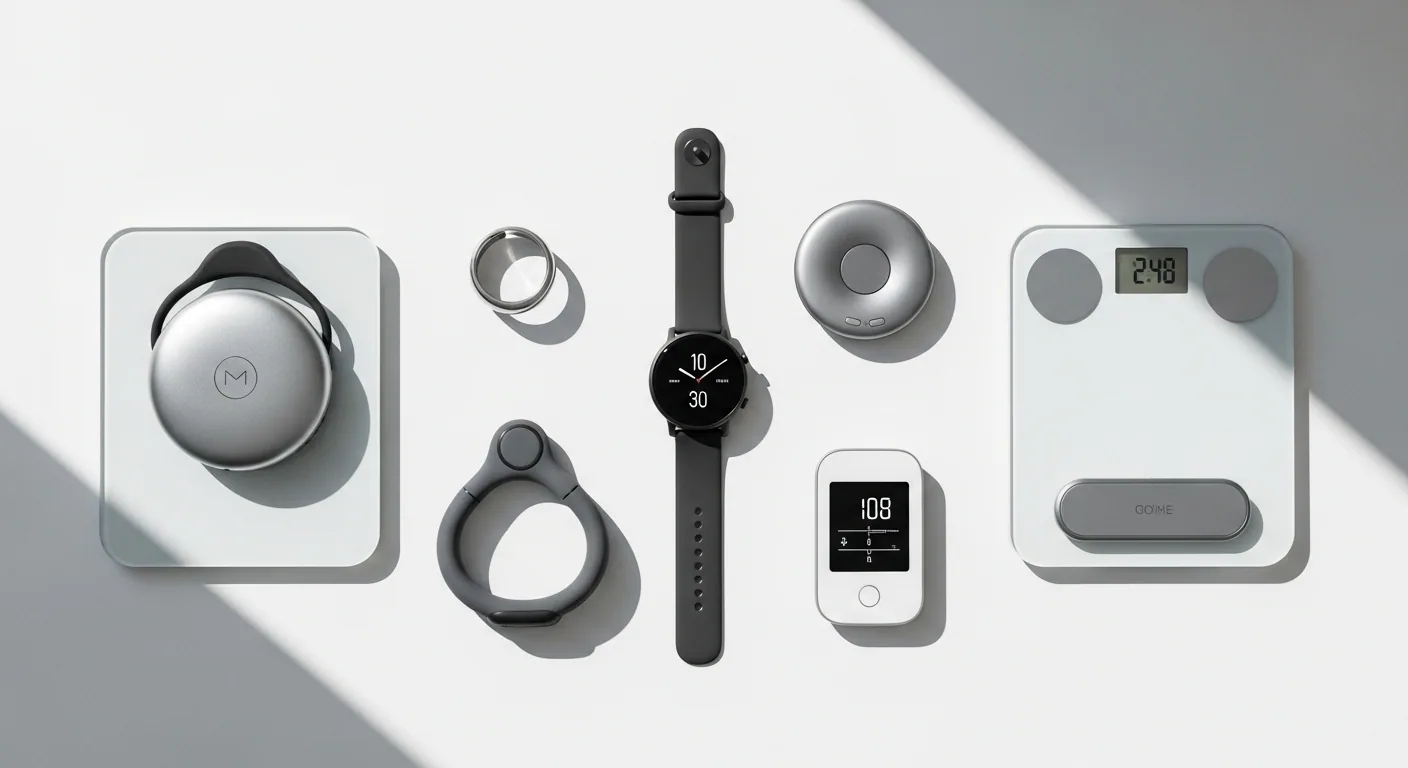
Here are seven devices that actually deliver on the promise of personalized wellness in 2026.
1. AuraSense Pro Smart Ring
If you've ever felt like smartwatches are unnecessarily bulky—congratulations, you're not alone. The AuraSense Pro is for people who want comprehensive health data without turning their wrist into a computer. This thing is a ring. An actual ring. It sits on your finger and quietly monitors your heart rate variability, blood oxygen, skin temperature, and activity without any screen demanding your attention or broadcasting to everyone that you're "health-tracking."
What actually sets it apart is the predictive AI engine. It doesn't just tell you what happened yesterday; it tries to forecast what's coming. Elevated HRV trends might mean you're heading into overtraining. A dip in sleep quality combined with higher evening resting heart rate might predict that you're catching a cold. This forward-looking approach means you can adjust your behavior before you're sick or burnt out, not after. The ring learns your personal baselines—which is crucial, because "normal" looks completely different for different people—and flags deviations that matter for you, not generic population averages.
The battery lasts 5-7 days depending on usage, which is genuinely impressive. The subscription model for advanced features is annoying (you'll get the basic data without it, but the real personalization requires the upgrade), and yes, these aren't cheap. But if you're already buying one expensive wellness gadget, a ring is the least obtrusive option.
Best for: Someone who wants serious health insights without the aesthetic commitment of wearing a smartwatch.
2. NeuroCalm AI Headband
Your brain isn't a fixed thing. It's plastic, trainable, and right now it's probably running some very inefficient patterns around stress and focus. The NeuroCalm AI Headband acknowledges this and then does something most meditation apps never do: it gives you objective feedback.
EEG sensors in the headband read your brainwaves in real-time and show you what's actually happening in your head when you're "meditating" or "focusing." Turns out, a lot of people aren't doing either—they're just sitting quietly and calling it meditation. The NeuroCalm's AI learns what your relaxed brainwave patterns look like, then guides you toward them using sound, gentle vibration, or micro-stimulation. It's biofeedback at the neuroscience level. You get immediate, measurable evidence of whether your meditation is working, and the AI adapts the experience session by session based on what your brain actually responds to.
The tradeoff is real though: there's a learning curve. The first few sessions feel weird because you're not used to external feedback on internal mental states. And frankly, it's not going to replace therapy or medication for serious mental health conditions—it's better thought of as a brain training tool than a clinical intervention. The price is higher than a meditation app subscription, but if generic mindfulness never clicked for you, the personalized approach here actually works differently.
Best for: Someone who's tried meditation apps, found them vague or ineffective, and wants proof that their brain is actually changing.
3. NutriGenius AI Smart Scale & Blender System
Calorie counting is brain-dead. Your body isn't a simple math equation. You can eat 2,000 calories a day and have completely different results depending on what those calories are, when you eat them, and how your unique metabolism processes them. The NutriGenius system ignores the calorie mythology and instead obsesses over biometrics.
The smart scale reads your body composition—not just weight, but the ratio of muscle to fat to water—and pairs that data with activity from your other devices and even genetic data if you've done a DNA kit. Then the AI's blender program generates recipes with specific macronutrient ratios designed for your current goals and your current metabolic state. This isn't "eat more protein"—it's "eat 42 grams of protein, 18 grams of fat, and blend these specific ingredients because your body composition trend shows you're losing muscle alongside fat, which means your current diet isn't working."
The system updates dynamically. If your body composition shifts, recipes adjust. If your activity increases, the algorithm recalibrates. It functions like having a nutritionist who actually pays attention instead of giving you the same advice as everyone else. The blender itself isn't a gimmick—it's optimized for consistency and can be scheduled to prep ingredients at specific times.
The catch: you need to actually use it. If you buy the system and then grab fast food anyway, the AI can't help you. And yes, there's privacy anxiety here—you're feeding a company detailed information about your body and dietary patterns. That's worth considering before purchase.
Best for: Someone who's tried generic diet plans, seen inconsistent results, and wants nutrition that actually adapts to their biology.
4. SleepSync AI Mattress Topper
Most sleep advice is generic nonsense. "Get 8 hours." "Keep your room cool." "Avoid screens before bed." You could follow all of it and still sleep terribly, because your sleep problems are specific, not universal. The SleepSync topper treats sleep like what it is: a complex physiological system that can be optimized through data.
The topper has sensors embedded throughout and can dynamically adjust firmness in different zones, temperature, and even provide gentle vibrations that guide you into deeper sleep stages. That last part sounds weird until you understand that it's using gentle, timed pulses calibrated to your specific sleeping position and brainwave patterns to essentially coach you deeper into REM and slow-wave sleep. The AI learns whether you sleep better slightly warmer or cooler, firmer or softer, with or without vibration support.
The reports you get are actually useful. Instead of generic "sleep score," you get breakdown of how much time you spent in different sleep stages, what triggered awakenings, and what changes actually moved the needle. The integration with smart home systems means it can dim lights and adjust your room temperature automatically, turning your entire bedroom into an optimized sleep environment rather than just a bed.
It costs serious money—this isn't an impulse buy. Installation is annoying because it sits on top of your existing mattress. And if you share a bed with a partner, the zoned adjustments mean you each get personalized support without disrupting the other. Some people notice benefits within days; others take weeks to adapt to the technology.
Best for: Someone with chronic sleep issues who's willing to invest significantly and experiment with their sleep environment.
5. VitalityLink AI Home Health Hub
You have a smart ring. Maybe a smart scale. A sleep tracker. Your phone counts steps. But these devices live in isolation—they don't talk to each other or to you in a unified way. The VitalityLink Hub is the central processor that makes them all meaningful.
This device sits somewhere central in your home and becomes the nervous system of your wellness ecosystem. It aggregates data from everything connected to it, and more importantly, its AI looks for patterns that no single device would catch. Maybe your ring shows slightly elevated heart rate, your scale shows you're retaining water, and your sleep data shows you woke up more—individually, each of these is noise. Together, they're a signal that you're probably getting sick. The hub can flag this and suggest preemptive action before you're symptomatic.
For families or households where you're monitoring elderly relatives or managing health for multiple people, this becomes genuinely valuable. The AI can notice subtle changes in behavior or health markers that might indicate a fall risk, cognitive decline, or early disease. It's privacy-conscious by design—you're not installing cameras, just data aggregation. It also handles annoying stuff like medication reminders and can integrate with telehealth services, which means less coordination on your part.
The tradeoff is complexity and privacy concerns. You're centralizing a lot of health data in one device connected to the internet. That requires trust in the manufacturer's security practices. And setup can be tedious if you have many connected devices.
Best for: Someone who's already invested in multiple wellness devices and wants to extract meaningful patterns from the data, especially families managing health for multiple people.
6. ActiveFlow AI Smart Apparel
The moment you put on smart fabric instead of a smartwatch, everything changes. ActiveFlow integrates sensors directly into the clothing, so you're not wearing in addition to your workout gear—this is your workout gear. The difference is massive for data quality because the sensors are precisely placed at points relevant to your biomechanics.
During a workout, the apparel tracks which muscles are actually firing, whether your form is degrading as you fatigue, your balance, your breathing rate relative to effort. The AI gives you real-time feedback—sometimes through haptic (vibration) cues that directly correct you, sometimes through an app. If you're squatting and your knees are caving inward (a common injury pattern), the apparel senses this and literally taps you to correct it before you reinforce bad movement patterns.
After workouts, the system analyzes muscle fatigue and inflammation, then serves you specific recovery recommendations: this muscle group needs 48 hours, this one needs ice, your overall system needs magnesium intake based on electrolyte depletion. Over time, the AI learns your movement patterns, your injury vulnerabilities, and can predict what's at risk of breaking down before it actually does.
The practical tradeoff is durability and maintenance. These are smart fabrics, not regular athletic wear. They need careful washing. Battery life in the sensors is improving but still a limitation. And you need to wear multiple pieces to get full-body tracking, which multiplies the cost.
Best for: Serious athletes and fitness enthusiasts who want injury prevention and performance optimization through real-time biomechanical feedback.
7. ClarityLens AI Smart Glasses
Glasses are something you're already wearing (or would be, if you need correction). ClarityLens replaces them with eyewear that secretly monitors your well-being while you go about your day. The sensors track eye movement, facial micro-expressions, and even heart rate variability through contact points on the frame. None of this is noticeable to you or anyone else.
The AI interprets these signals as mood, stress level, and cognitive load. When it detects rising stress (validated through physiological markers, not guesses), it can vibrate subtly to alert you, or project a gentle prompt into your field of vision suggesting a breathing exercise or a break. You get reminders to hydrate, posture corrections, and even real-time information about your environment—all without pulling out your phone and breaking focus.
This is contextual wellness. Instead of a device telling you generic things at random times, it's responding to what your body is actually signaling in real time. The AR layer is restrained compared to sci-fi hype, but useful: time until your next meeting, relevant health reminders, or even meditation cues appear in your peripheral vision.
The price is steep, and battery life is a real consideration—these are meant for all-day wear, but you'll definitely be charging daily. There's also legitimate privacy anxiety: you're wearing cameras and extensive sensors on your face. That matters.
Best for: Someone who spends their day in front of screens and wants passive, moment-to-moment wellness support without constant device interaction.
How to Choose the Right AI Wellness Devices
What Problem Are You Actually Trying to Solve?
Start here, not with the gadgets. Are you trying to sleep better? Manage stress? Optimize fitness? Eat more intelligently? Every device on this list is excellent at something specific and mediocre at everything else. The AuraSense ring is phenomenal for detecting physiological trends but terrible at coaching your workout form. The ActiveFlow apparel is surgical for biomechanics but won't help with sleep optimization. Clarity about your primary goal eliminates 70% of wrong choices.
How Much Data Integration Do You Actually Need?
Some people want one device that does one thing beautifully. Others want a full ecosystem where everything talks to everything. The VitalityLink hub only makes sense if you're already committed to multiple connected devices. The smart apparel works standalone. A smart ring is self-contained. Think honestly about whether you want to manage a connected ecosystem or prefer simplicity. Adding devices because they're "cool" turns into a data management nightmare.
Subscription Model and Hidden Costs
Many of these devices have base prices that look reasonable until you add the subscription for advanced AI features—which is where the personalization actually happens. AuraSense, NutriGenius, and others require monthly fees to unlock the machine learning that makes them worthwhile. Budget for this. Some people are comfortable with it; others find it insulting. Neither judgment is wrong, but you need to decide which camp you're in before purchasing.
Privacy vs. Functionality Trade-off
Personalized AI requires data. Period. The more advanced the personalization, the more data the company has about you. Some of these devices collect continuous biometric data, location data, and detailed behavioral patterns. Evaluate the manufacturer's privacy policy and your own comfort level. If centralized health data feels invasive, you might skip the hub or reconsider smart apparel. This isn't a technical problem with a technical solution—it's a values decision.
The Future of Personalized Wellness Technology
If you're buying just one device, the AuraSense Pro Smart Ring is the closest thing to a universally useful option. It provides genuine predictive health insights without aesthetic sacrifice, works standalone, and the data is genuinely actionable. The learning curve is zero.
If you're willing to invest in solving a specific problem, NeuroCalm AI Headband works for mental wellness and ActiveFlow AI Smart Apparel works for fitness/injury prevention in ways nothing else does. Both are specialized but genuinely good at their specialization.
The direction these devices are heading is clear: less screen time, more passive monitoring, smarter interpretation of your data, and increasing integration with your environment. The next wave won't feel like "technology"—it'll feel like having a genuinely attentive coach who knows you intimately.
Pick the device that solves your actual problem, not the one with the coolest marketing. Give it 4-6 weeks of consistent use before judging. Your personalized wellness future is already here—it just requires choosing what matters to you first.
Related posts

8 Gourmet Pantry Essentials Reviewed: Our Honest Picks for Quality Cooking

Retainer Brite Cleaner Tablets Review: The Easy Way to Keep Your Retainers Fresh

6 Kids Toys Reviewed: Our Honest Picks for 2026